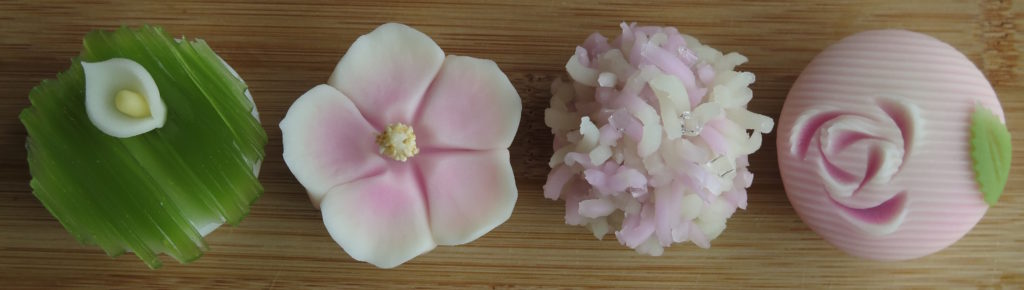
If you've ever been to Japan, your eye has surely been caught by these small, colorful, beautifully wrapped treats: these are wagashi (和菓子). These traditional sweets are, as their name suggests, quite specific to Japan ("Wa 和" meaning Japanese, and "kashi 菓子" sweet or cake), as opposed to yōgashi (洋菓子), that is to say, Western pastries.
Wagashi (和菓子) throughout Japanese eras
Wagashi (和菓子) were introduced to Japan during the Nara period (710-794), but it was the rise of Buddhism during the Kamakura period (1185-1333) that allowed the spread of these cakes, which were part of the vegetarian diet of Buddhist priests.
Then, Western pastries were introduced to Japan by the Portuguese and Spanish from the 16th century onwards. Very sweet and made from wheat, these cakes influenced the making of Japanese wagashi (和菓子).
Subsequently, the development of the tea ceremony during the Edo period (1600-1868) saw the emergence of a wide variety of confectionery. Finally, the Meiji era (1868-1912), marked by the opening of the country to the West, allowed for the development of new confectionery techniques, notably with the introduction of the kiln.
As is often the case with Japanese food, the art of making these delightful sweets developed primarily through religion, spirituality, and rituals. Today, wagashi (和菓子) are often enjoyed as a snack with green tea and still hold an important place in the tea ceremony.
Wagashi (和菓子) throughout the seasons
In Japan, people like to mark the changing seasons, especially through food, which should reflect the beauty of nature as much as possible. While wagashi (和菓子) are eaten year-round, they follow the rhythm of the seasons. Thus, cakes are adorned with white in winter and pink in spring, and some sweets are seasonal, such as... hanabiramochi, consumed at the beginning of the year, the sakuramochi of March, the hanamidango tricolour of April or even the
kuzuzakura of the month of July, to name just a few.
Wagashi (和菓子) have one thing in common, regardless of the season: these little bites are always very pretty, even sophisticated!
Douglas Perkins, CC0, via Wikimedia Commons
Wagashi (和菓子) in all its forms
There is such a wide variety of sweets that it's difficult to provide an exhaustive list! However, some basic ingredients are common, such as cane sugar and beans. azuki or the dough anko (餡子), rice or wheat flour, as well as kudzu or agar-agar (寒天, kanten) for frosts.
In the Japanese industry, these confectionery products are divided into three official categories, determined according to their water content:
- the namagashi (生菓子), which contain more than 40 % of water,
- the han-namagashi (半生菓子), containing between 10 and 40 % of water,
- the higashi (干菓子/乾菓子), which contain – 10 % of water.
Wagashi (和菓子) are also classified according to their method of preparation:
- Mochi mono (もち物), made from mochi rice. Ex: daifuku (大福)
- Mono mushi (蒸し物), steamed. Ex: mushimanju (蒸し饅頭)
- The mono nagashi (流し物), made by pouring the ingredients into a mold. Ex: yōkan (羊羹)
- The Neri Mono (練り物), made by shaping bean paste. Example: the nerikiri (練り切り)
- Mono oka (岡物), prepared by combining ingredients separately). Ex: monaka (最中)
- Mono uchi (打ち物), placed in a mold and hardened by hammering). Example: the rakugan (落雁)
- The yaki mono (焼き物), which are cooked; includes types that are cooked on a copper plate called a hiranabe (平鍋) and the baked types. Ex: dorayaki (どら焼き)