
In Japan, kawaii (可愛い) is everywhere, from small street shops to large corporations, from the government to city halls, from video games to cuisine. An example? Latte art cafes!
What are latte art cafes?
These are cafes that specialize in latte art, that is, the techniques of creating designs or patterns with milk or milk foam on the surface of a coffee or chocolate.

The process is not new (latte art appeared a little over 20 years ago in the United States) and you have probably already seen (or ordered!) these famous drinks dressed with a rosette or a heart of milk.
The Japanese have clearly recognized the kawaii potential of the concept. Out with the rosette, in with Pokémon, Totoro, pandas, and other cats – the only limit is your imagination! In 2D or 3D, these highly photogenic kawaii drinks spark conversations among friends as they decide which one is the most beautiful and what the next round will be all about.
One of the best latte art cafes in the capital, just a stone's throw from the school!
And as luck would have it, one of the best latte art cafés in the capital is located just a few hundred meters from Espace Langue Tokyo! It's Reissue café, which receives rave reviews. If you want to try Japanese-style latte art, this is undoubtedly THE place to go! The barista (or rather, latte artist) can bring your wildest ideas to life. You can even bring photos that they'll reproduce on your drink (within the limits of their skill, of course!).
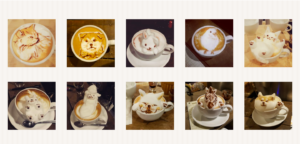
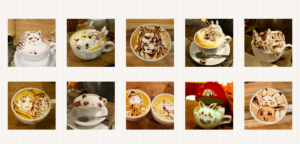 Photos: https://www.reissue.co.jp/gallery/
It will generally cost you around 1000 yen (8 euros) to enjoy this experience. If you would like to know more (address, opening hours, menu, etc.), we invite you to visit their website. https://www.reissue.
* Originally, the word kawaii, then written かわゆい (kawayui), referred to characteristics that aroused pity. The adjective later evolved into its current form, かわいい, as well as its kanji form, 可愛い. The latter is composed of "可," meaning "capable of" in this context, and "愛," meaning "affection" or "love," which can thus be translated as "adorable.".
However, the original meaning also allows for the addition of the sense of "vulnerable" or "fragile," like a child, and therefore the sense of childlike and small. Adopted by the magazine CUTiE in the late 1980s, kawaii has become an integral part of Japanese women's identity.
The word kawaii can be used to describe animals, people (without necessarily making a distinction of sex or age), objects, landscapes, situations or even ideas of all kinds; to describe people with a "cute" personality; to refer to small, round things (in fact, the word is very often used to refer to babies); in cases where elderly people act in a childish way or when adults show signs of innocence or other traits specific to childhood; to refer to a character considered cute.
Source : https://fr.wikipedia.org