Japan is a country imprint of traditions. Some practices are becoming rarer and tending to disappear, but it is still possible to appreciate, even today, ceremonies that are several centuries old. This is the case of yabusame (流鏑馬), this particular practice of archery. .
A brief history of yabusame (流鏑馬)
 The yabusame (流鏑馬Horse archery is a technique of archery on horseback. It is an ancient practice, used in both hunting and warfare. While the Japanese are known worldwide for their swordsmen (the famous samurai), it is worth noting that the bow was the favorite weapon of Jinmu Tennō, the legendary emperor and founder of Japan. It is therefore a weapon with strong symbolic significance.
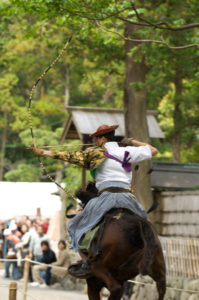 The yabusame (流鏑馬) appeared during the Kamakura period (1185-1333) under the impetus of the shogun* Minamoto no Yoritomo (源頼朝), concerned with filling the shortcomings of his samurai.
The training was extremely rigorous, to the point that if the archers obtained poor results, they could be ordered to commit seppuku. 切腹, ritual form of suicide. It must be understood that being chosen to become a yabusame archer (流鏑馬) was a very great honor, exclusively granted to the best warriors.
With the modernization of weapons of war, and in particular the arrival of rifles in the mid-16th centuryth In the 19th century, yabusame (流鏑馬) fell into disuse and then reappeared during the Edo period (1600-1868). The archipelago was at peace, and archery became more of a method of personal development. Yabusame (流鏑馬) thus transformed into a martial art, combining warrior discipline with spirituality borrowed from Zen Buddhism and Shintoism.
Yabusame (流鏑馬) today
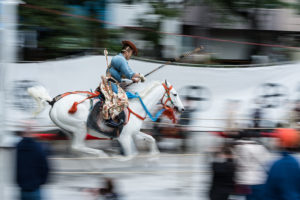 Even today, there are two schools of yabusame (流鏑馬): the Ogasawara Ryu school and the Takeda Ryu school. In practice, the sport involves hitting three targets arranged along a 225-meter track. The placement of the targets represents the weak points of Japanese armor. During the race, the rider can only steer the horse with their legs, as their arms are occupied holding the bow and arrows. When approaching a target, they place the arrow in front of their ear before releasing it with the cry of "« In-yo-in-yo »"("Darkness and light").
The extreme rigor of this practice has led to its ritualization. While it was once described as a way to attract the favor of the deities, today yabusame (流鏑馬) is seen as a ritual rather than a sport due to its solemnity and religious aspect. It is often practiced during special ceremonies or official events.
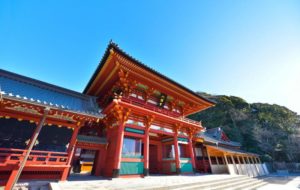
It is possible to attend yabusame (流鏑馬) performances every year at the Tsurugaoka Hachimangu Shrine in Kamakura, near Tokyo. They take place in April and September.
* The term shogun means "general". It is an abbreviation of seii taishōgun (征夷大将軍), which can be translated as "great general who pacified the barbarians." However, after it was bestowed upon Minamoto no Yoritomo, it became a title often indicating the de facto ruler of Japan (military dictator), even though the emperor remained the de jure ruler (in a sense, the guardian of traditions). The title of seii taishōgun was subsequently abandoned during the 19th-century constitution.th century of the kazoku, that is to say, of the Japanese nobility.
Source : https://fr.wikipedia.org/wiki/Shogun
Photos: Jmills74, CC BY-SA 3.0 , via Wikimedia Commons / Ginko Adachi (active 1874-1897), Public domain, via Wikimedia Commons /Takashi Hososhima from Tokyo, Japan, CC BY-SA 2.0 , via Wikimedia Commons /