Among the deities that populate Japanese folklore, Raijin (雷神), thunder kami and Fujin (風神), Wind spirits play an important role. Spreading blessings or calamities, they are both feared and revered in the archipelago.
Story of the two kami (神)
Once upon a time, there was Izanami, the primordial goddess. Izanami lost her life giving birth to the fire god, Kagutsuchi. She then passed into the underworld, the yomi no kuni. Devastated, her husband Izanagi set out to find her. But his beautiful wife had transformed into a decaying body, inhabited by a soul consumed by hatred. He also discovered that Izanami had given birth several times in the underworld. However, this offspring was more like yōkai (evil creatures) than kami (gods). Horrified, Izanagi fled, which enraged Izanami. She ordered Raijin and his monsters to pursue Izanagi and avenge her. Before Izanagi could block the passage between the realms of the living and the dead, Raijin, Fujin, and other monsters managed to escape. Since then, Raijin and Fujin have been terrorizing Japan.
*Not to be confused with Buddhist hell – more info on the excellent website Japanization
Feared and revered kami
Raijin and Fujin are therefore descendants of the primal goddess Izanami, born in the world of the dead.
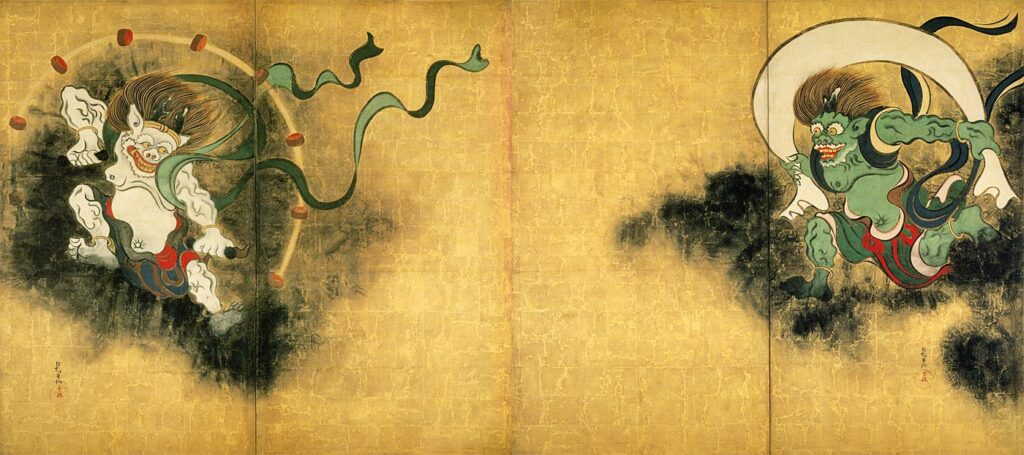
Raijin (雷神) has red skin and three fingers on each hand (representing the past, present, and future). He possesses a whole array of drums which he uses to create thunderous sounds. Fujin (風神), on the other hand, has green skin and four fingers on each hand (representing the four cardinal directions). He possesses a cloth containing the wind, which he controls at will.
The two brothers waged a more or less "friendly" celestial war to determine who would control the heavens. Violent storms and powerful typhoons: the repercussions of the battles between the brothers could be severe for the Japanese. The two brothers, however, remain kami (deities), and many people venerate them for their protection. For example, it is said that Fujin and his divine wind thwarted the Mongol invasion attempt in the 13th century. It is also said that it is a good omen for rice paddies to be struck by Raijin's lightning: this is believed to promise a bountiful harvest.
During your next visit to Tokyo, we recommend visiting Senso-ji Temple. There you can admire the Thunder Gate and the two statues of Raijin and Fujin, protectors of the temple.