
For several years now, tattoos have been all the rage in France. In fact, it's estimated that one in five people has at least one tattoo. The fact is, tattoos have become a real fashion accessory. But what about in Japan?
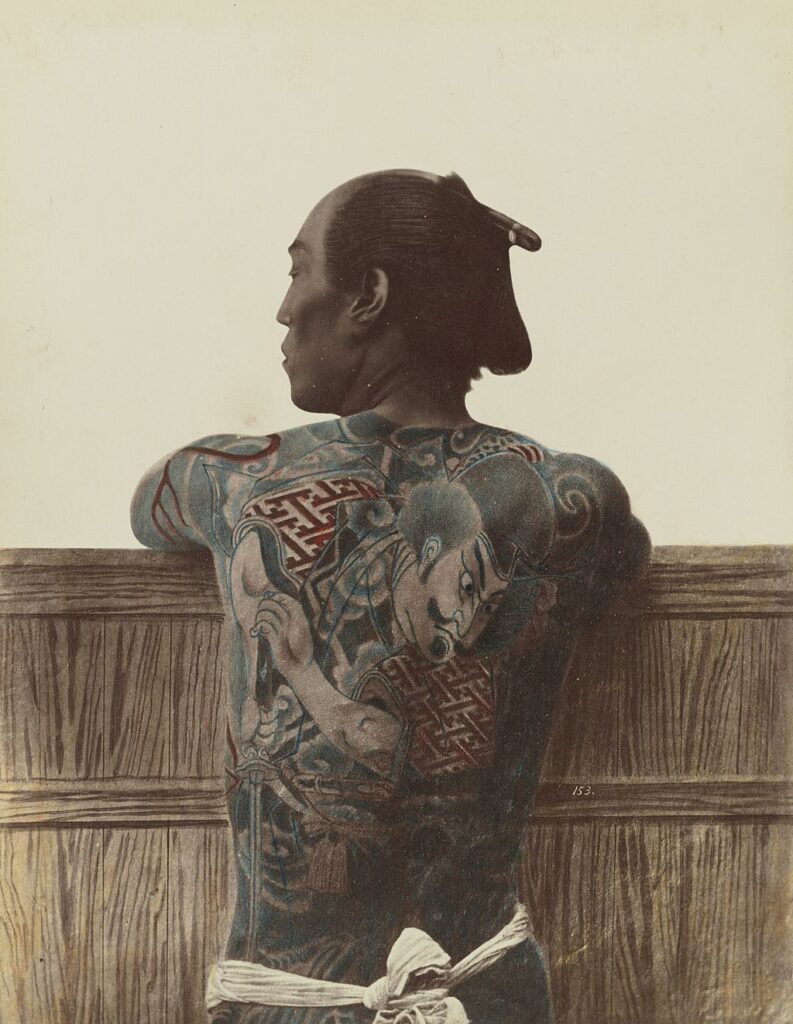
It's no secret that Japan has a complicated relationship with tattoos. One could even speak (to some extent) of ostracizing tattooed people. Indeed, simply having a tattoo will bar you from most onsen (hot springs), sento (public baths), swimming pools, and gyms. Access to certain beaches is also prohibited for tattooed individuals. However, tattoos are not illegal, and attitudes are changing—slowly but surely. To better understand the place of tattoos in Japanese society, a little history is necessary.
History of Japanese tattooing
The practice of tattooing in Japan is extremely ancient and dates back to the Jomon period (10,500 BC to 300 BC). At that time, tattoos had an important socio-cultural function. They served, for example, to indicate one's profession, clan affiliation, marital status, or even for protection (like an amulet).
Over time, the practice evolved, and tattooing became primarily the preserve of two categories of people: criminals and the "brave." Those who had committed serious crimes would tattoo their foreheads, for example. The "brave," on the other hand, would highlight their acts of bravery. During the Edo period (1603-1867), tattooing even became a refined fashion accessory for the wealthy classes of Japanese society.
Tattoos and ヤクザ
However, another class would adopt tattoos: the yakuza (ヤクザ, the Japanese mafia). Traditional Japanese tattooing, or irezumi (入れ墨), being very painful, marking oneself all over the body was a demonstration of courage, determination, and devotion to the clan. This phenomenon became so widespread that tattooing became exclusively associated with the yakuza, ultimately leading to the outlawing of tattoos in 1872.
Post-war tattoos
The ban on tattoos in Japan was completely lifted in 1948, under the post-war American occupation. Nevertheless, the negative image associated with the Japanese mafia remains deeply ingrained in society, hence the many places that still prohibit tattooed individuals today. Fortunately, if you have tattoos, you'll be happy to know that attitudes are changing. The drastic reduction in the number of yakuza, along with the popularization of tattoos by major icons in entertainment and fashion, is softening the Japanese perception of tattoos.
In 2014, according to a survey conducted by members of the Federation of Kantō Bar Associations among 1,000 men and women aged 20 to 60, 16 had tattoos. This proportion remains low compared to most Western countries, where it ranges from 10 to 25. Nevertheless, it indicates that Japanese society has begun to view tattoos as a genuine form of aesthetic expression.
Continue reading!
More information about the history of tattooing over time can be found on the website. nippon.com