
Japan has officially announced the resumption of tourism, and you're probably planning your next trip to the archipelago. But be warned! Unlike the French, who have abandoned masks, the vast majority of Japanese continue to wear them daily. Therefore, if you want to avoid any inconvenience during your trip (and not give us a bad reputation with the Japanese!), we strongly advise you to wear a mask on public transportation and in public places. Furthermore, masks are considered a common everyday accessory in Japan. But do you know why?
Origins that date back to the Edo period
This may surprise you, but covering one's mouth is an ancient practice. In the past, it was customary to cover one's mouth with cleyera (a plant native to Japan) to avoid defiling religious rituals with an impure mouth. We know, particularly from prints, that this practice began to develop during the Edo period (1603-1868), although it remained marginal.
Modern masks
Modern masks appeared at the end of the 19th centuryth In the 19th century, these masks were not intended for the general public. In fact, miners wore them to protect themselves during their arduous work. Outside of this context, masks were also available for purchase in pharmacies, for example. However, these were relatively expensive, and their purchase was not commonplace.
Masks and the Spanish flu
The major event that popularized mask-wearing in Japan was the devastating Spanish flu epidemic. Between 1918 and 1919, the scourge swept across the globe – one of the deadliest pandemics in human history (between 40 and 50 million deaths). The need for protection, combined with various advertising and media campaigns, convinced the Japanese to use masks for effective protection against the flu (the first flu vaccine was developed in 1930). Masks then became essential during flu seasons. The practice became so widespread that masks became an everyday accessory, used whenever someone suffered from an illness that could transmit germs. This is why, even today, masks are widely used by people suffering from hay fever, for example.
Masks in Japanese culture
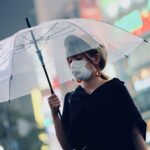
To understand what makes this practice uniquely Japanese, one must consider Japanese culture. In Japan, it is not the individual but the group that is central to societal thinking. In other words, it is up to the individual to do everything possible to avoid disrupting the daily life of the group. Consequently, wearing a mask when suffering from something as common as a cold is actually a sign of consideration for those around us. And it is precisely this consideration for others that characterizes (among other things) Japanese culture.

More anecdotal, but nonetheless widespread enough to be noted, the mask has found its audience for other reasons. Indeed, for some, it has become a fashion accessory. From a woman's perspective, women can also use it when they want to go out without having to wear makeup. Finally, some people use it to protect themselves from the image they project to the outside world.
As you might have guessed, Japan didn't wait for COVID-19 to popularize mask-wearing. The panic this pandemic generated explains why, even today, the vast majority of Japanese people wear masks daily. But ultimately, wearing a mask in Japan is simply a symbol of consideration for others. So don't worry, if you need to wear a painless mask to enjoy all the wonders of Japan, there's no need to make a big deal out of it…
Continue reading!
Take a look at this article on marianne.net In Japan, authorities are struggling to encourage residents to… remove their masks
The health measures on the site from the Embassy of Japan in France
![[Japon Pratique] 5 chaînes de restaurants à découvrir](https://espaceprof.com/wp-content/uploads/2021/06/thomas-marban-EHK-EH1SRzQ-unsplash-scaled-1-400x300.jpg)