Kunchi Nagasaki is the flagship autumn event of the famous prefecture in southwest Japan. The origin of this exciting and colorful festivalThe festival dates back over 380 years. Held annually from October 7th to 9th, it celebrates the deities of the Suwa Shrine. The festival and its dances have been recognized as part of the intangible cultural and folk heritage since 1979. Unfortunately, the 2022 festival was (again) cancelled due to the coronavirus.
Origin and history of the Kunchi Nagasaki festival
Kunchi literally means "9th day of the 9th month of the lunar calendar" (ku (く), 9 / nichi (にち), day). Legend has it that the festival began in 1634. Two prostitutes, Takao and Otowa, are said to have dedicated a song and dance performance to the Suwa Shrine in Nagasaki. However, it appears that the festival was originally an event to celebrate the end of the autumn harvest. When the Suwa Shrine was completed (1642), the festival is believed to have become a traditional gathering to counter the rise of Christianity in the archipelago. Over the centuries, and with the reopening of Japan at the beginning of the Meiji era, the festival evolved. It incorporated elements of Dutch, Portuguese, and Chinese cultures, which played a significant role in Nagasaki's prominence, as the city was the only gateway to Japan.
Thus, the Kunchi festival in Nagasaki is the perfect representation of the cultural diversity of Nagasaki throughout its history.
What kind of party?
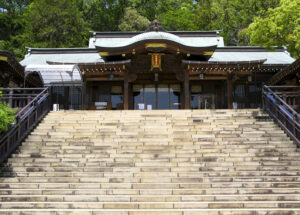
The Kunchi Nagasaki Festival is centered around the Suwa Shrine area. Portable shrines, carrying the bodies of the shrine's deities, depart for Otabisho Shrine. They return to their original location the following day. During this time, dance troupes from seven of Nagasaki's 59 wards take turns performing in front of the shrine. They make offerings in the form of dances or a procession of floats. However, the festivities are not limited to the shrine. They take place in several locations, and it is possible to attend without a ticket or reservation. Expect to be caught up in an energetic and boisterous crowd shouting: "Koi mound, koi mound! More! More!".
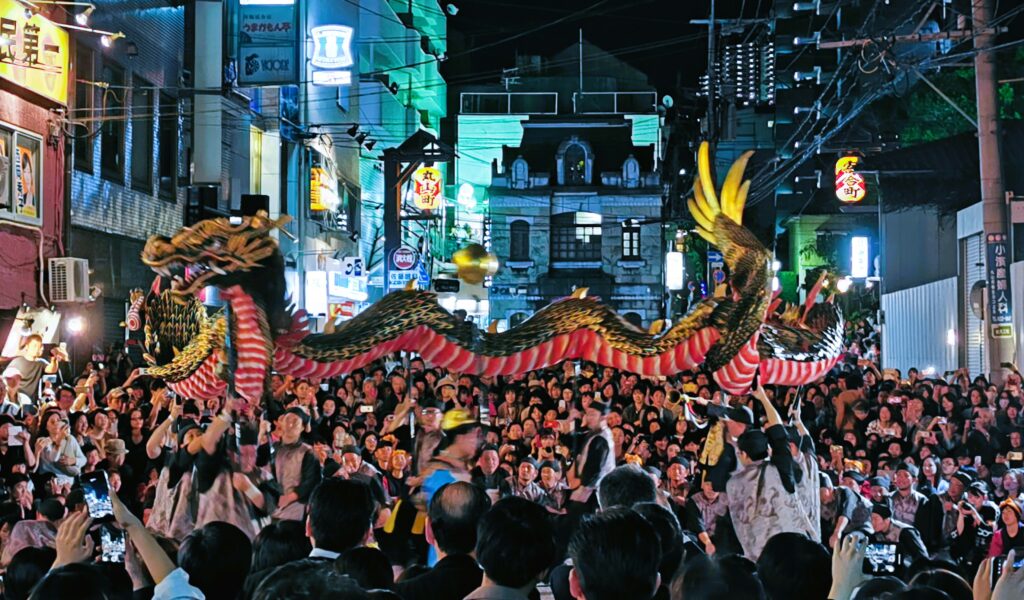
Dragon Dance 龍踊り (Jaodori)
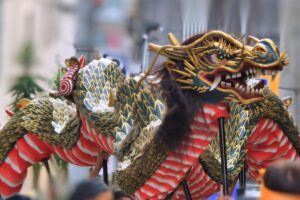
The dragon dance is the emblematic dance of the Kunchi Nagasaki Festival. Of Chinese origin, it is part of Nagasaki's cultural heritage. It can also be enjoyed during the Chinese New Year in several districts of the city. This dance features a dragon about ten meters long, made of fabric and papier-mâché. At its base, a dozen wooden rods manipulated by dancers bring the dragon to life with incredible realism.
Expulsion of water by the whale 鯨の潮吹き (Kujira no Shiofuki)
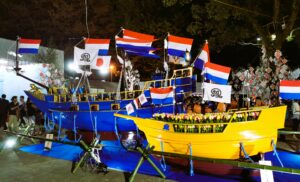
This "offering" reveals the centuries-old attachment of Japanese culture to whaling. The Kujira no Shio Fuki features three main floats. The first float is shaped like a whale, the second like a boat, and the last like a warehouse.
The "whale chariot" is pulled by about ten people. It repeats rotating movements for about twenty minutes while releasing jets of water about ten meters high.
Continue reading!
The official website of the festival by here (in English)