
May 3rd marks Constitution Day in Japan. It is part of Golden Week and celebrates the 1947 constitution, which came into effect in Japan a few years after the end of World War II.
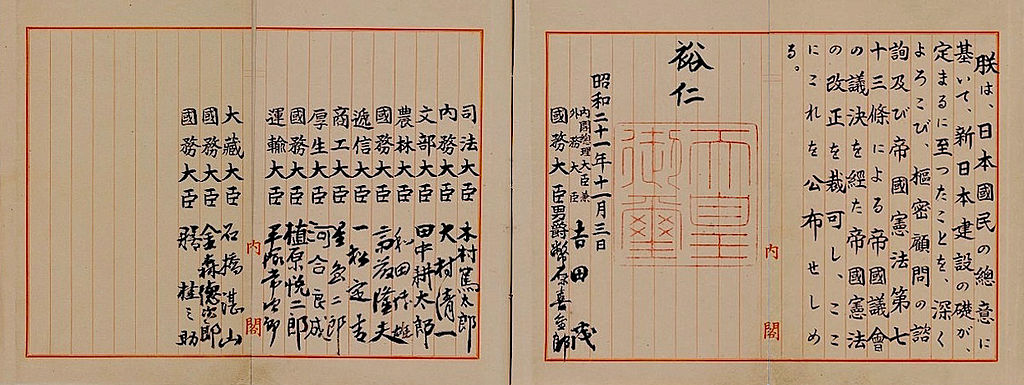 The Constitution of the Empire of Japan of 1889
The Constitution of the Empire of Japan, which came into effect in November 1890, (大日本帝國憲法, dai-nippon-teikoku kenpō, literally "Constitution of the Empire of Greater Japan", or "Meiji Constitution"«) is the first fundamental law of the Empire of Japan.
This text had two objectives:
- to project the image of a modern country in order to be able to negotiate on an equal footing and
- to strengthen the legitimacy of the new imperial power in the context of the imperial restoration.
It draws upon the various existing systems in Europe, notably those of Prussia and Austria-Hungary. However, a problem arises: the conflict between the principles of imperial sovereignty and constitutional government. Nevertheless, this Constitution marks a decisive turning point in the modernization of institutions.
The Constitution of the State of Japan of 1947
The Constitution of the State of Japan (日本国憲法, Nihon-koku kenpō) date of the end of the Second World War. effective is inspired by the work of Douglas MacArthur, the supreme commander of the Allied occupation forces in Japan, who was determined to disarm and democratize Japan.
It differs from the previous version in the importance it attaches to three particular points:
- popular sovereignty (and not imperial sovereignty),
- respect for fundamental human rights and pacifism and
- the definitive renunciation of war (the famous Article 9).
The new Constitution still gives a central place to the imperial institution, but it is very much in keeping with the legacy of the Declaration of the Rights of Man and of the Citizen of 1789, with the objective of "defending natural and civil, sacred and imprescriptible rights".
The specific features of the Japanese Constitution
The Japanese Constitution has not been amended since its inception. While it is one of the few in the world that has never been modified, it has nonetheless been the subject of repeated calls for its revision. This movement intensified in December 2012, when Shinzo Abe indicated that constitutional reform was one of the priorities of his term; however, he left office in September 2020 without having made any changes.
The proposed amendments concern Article 9, which defines the renunciation of war:
«Chapter II. Renunciation of War”
Article 9. Sincerely aspiring to an international peace based on justice and order, the Japanese people forever renounce war as a sovereign right of the nation, or the threat or use of force as a means of settling international disputes.
To achieve the objective set forth in the preceding paragraph, no land, naval, or air forces, or other war potential, will ever be maintained. The right of belligerency of the State will not be recognized.»
This article divides Japan and generates conflict in Parliament. Indeed, for most Japanese, it represents a turning point in the era of imperialism and war. Nationalists, however, believe that the current geopolitical situation necessitates a revision of this article.
Furthermore, under American pressure, the text incorporated several social reforms, notably women's suffrage. Gender equality is enshrined in the Constitution: a world first!
Finally, the first "« "Meiji Constitution" marked the introduction, for the first time in Asia, of a Western-style constitutional system.