Every year on March 3, Japan honors little girls during a day of celebration called Hina Matsuri (雛祭り), literally "doll festival".
The origin of this festival dates back to the Heian period (794-1185)
The Hina Matsuri is one of the traditional Japanese festivals influenced by ancient Chinese philosophy. Indeed, popular belief held that days with an odd number, identical to their month, brought good fortune (January 1st, March 3rd, May 5th, July 7th, September 9th).
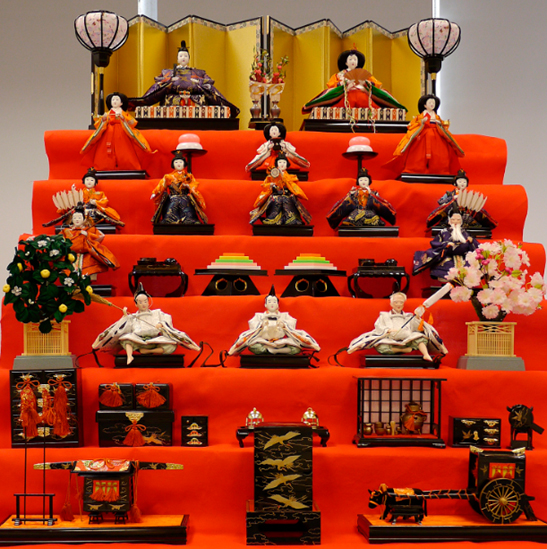
At that time, it was customary for nobles to acquire exquisite dolls representing the imperial couple and members of the court. These figurines were believed to absorb misfortune and protect against evil spirits. These dolls were then displayed on a staircase covered in red felt, following a specific order:
- Emperor Odairisama,お内裏さまand Empress Ohinasama,お雛さまon the top step
- Three maids on the second level
- Five musicians in the third row
- Various characters on the lower levels
The Hina Matsuri today
Today, for essentially practical reasons, the number of dolls is often reduced to the two main figurines of the imperial couple.
Peach blossoms can also decorate the doll altar. It's their blooming season, and these flowers are believed to have the power to ward off evil spirits. Hishimochi (菱餅, ひしもち), small, tricolored rectangular mochi, are also placed on the platform. White represents snow or mist, green represents buds, and red (or pink) represents peach blossoms.
Japanese girls display their precious dolls in the days leading up to March 3rd. Tradition dictates that the figurines be put away before the end of the celebration… otherwise, the wish will not come true!
The symbolism associated with this holiday has evolved. Nowadays, it's primarily about wishing for a healthy and successful life rather than marriage. For the occasion, little girls wear pretty kimonos and share traditional pastries with their friends and/or family. Dolls, meanwhile, can be replaced by kokeshi dolls or origami figures.
To find out where to see Hina dolls in Tokyo, consult the article from Living in Tokyo.
Continue reading
Kanbutsue & Hana Matsuri: Celebration of Buddha's birth & flower festival