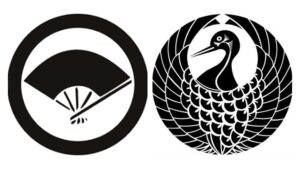
Kamon (家紋) are among the characteristic symbols of Japan. They are present everywhere, whether in popular culture or everyday life. Most Japanese families possess one, and for good reason: the kamon is none other than the family crest. While they can be compared, to some extent, to the coats of arms we know in Europe, some differences should nevertheless be noted.
Origin of the kamon
Their origins are believed to date back to the 11th century, towards the end of the Heian period (794-1185). At that time, the population was divided into castes. There was, for example, the Kuge (aristocratic caste) and the Buke (warrior caste). It is assumed that the aristocratic caste was the first to use Japanese crests. Affixing a crest to their possessions added prestige and served as a distinctive mark. Consequently, the motifs of the Kuge kamon were often elaborate and related to nature (it's important to remember that Japan is an animistic country).
Throughout Japanese history

With the great battles that punctuated the following centuries, the Buke also adopted the kamon. These served as distinctive symbols to differentiate allies from enemies on the battlefield. The crests of the warrior caste were often geometric in shape and less sophisticated than the aristocratic kamon.
The Edo period (1603-1868) marked a turning point in the use of coats of arms. The country, ruled by a shogun, experienced a period of peace. As a result, kamon (family crests) became more widespread. A major difference from coats of arms in Europe was that kamon were not the exclusive domain of the upper classes. In fact, at that time, commoners were not allowed to use family names; therefore, coats of arms served a useful purpose for identification.
The kamon today

After World War II, Japan was purged of most of its symbols deemed nationalist. Nevertheless, kamon remain deeply rooted in Japanese identity: even today, most Japanese families possess one or more crests. Generally speaking, they are less codified than European coats of arms. They can represent shapes, symbols, plants, animals, and so on. From clothing to objects, including house facades, places of worship, and even tombs; keep your eyes peeled!