Buddhism occupies a prominent place in spirituality in Japan. For almost 1500 years, this religion, imported from China (and originating in India), has established itself alongside Shintoism as a major spiritual, philosophical and religious current in the Archipelago*. It is therefore not surprising that the Japanese celebrate the birth of Buddha: this celebration is called Kanbutsu-e (潅仏会), literally "gathering to water Buddha".
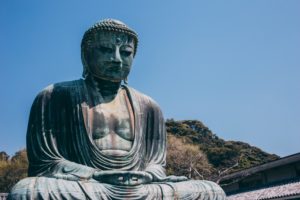
Buddhism in Japan
April 8th marks the birthday of Gautama Siddhartha, also known as Shakyamuni, O-Shaka-Sama in Japan, or simply Buddha (with a capital B to distinguish him from others who have acquired this title over time). He lived between the 6th and 5th centuries BC and is the historical founder of a community of wandering monks. which will give rise to Buddhism.
In Japan, Kanbutsu-e (潅仏会) is not an official national holiday but is nonetheless an important date. Over time, it became combined with another celebration, the Hana Matsuri (花祭り, the The flower festival), which is believed to have originated in the Shinto religion. It involved welcoming the deity who came to protect the rice harvest in spring by decorating bamboo poles with flowers.
The practice nowadays
 Nowadays, during Kanbutsu-e (潅仏会) / Hana matsuri (花祭), It is customary to decorate temples and altars with flowers.
A small structure called hana-mido (花御堂, the "flower pavilion") is on display, housing a standing statue in a large container covered with flowers. It is a "statue of the Buddha at birth" (tanjo butsu zo, 誕生仏像).
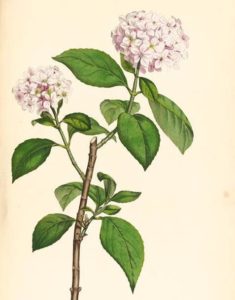
The container holds ama-cha (甘茶), which worshippers pour over the statue's head using a ladle provided. This is an infusion made from the leaves of a type of hydrangea with a pronounced sweet taste.
It is possible to participate in these celebrations at almost any Buddhist temple in Japan. In Tokyo, for example:
- At Gokoku-ji temple Near Ikebukuro, richly costumed young children are invited to pour...’ama-cha on the statuette to benefit from divine protection; ;
- At Senso-ji temple from Asakusa, a hana-mido golden houses a tiny statue and is displayed with a white elephant statue; ;
- THE Tsukiji Honganji Temple In Tsukiji, in addition to its baroque architecture, there is a white elephant on its forecourt, which also welcomes families with children for a giant picnic.
* These two religions can be expressed simultaneously in the form of an ancient syncretism called shinbutsu shūgō (神仏習合, literally "Shinto-Buddhist syncretism"«Most Japanese people have a neutral view of religion and practice several religions in their lives. Thus, the same person might go to pray at a Shinto shrine at New Year's or before school entrance exams, then have a Western-style wedding in a church, and finally a funeral in a Buddhist temple.
Source : https://fr.wikipedia.org/wiki/Religion_au_Japon#Syncr%C3%A9tisme_shinto-bouddhiste
Photo: By JE Smith http://www.illustratedgarden.org/mobot/rarebooks/page.asp?relation=QK98S657&identifier=0069, Public domain, https://commons.wikimedia.org/w/index.php?curid=19978909