
Although the night is only half over and the cold is noticeable even when bundled up in several layers, the shrines and temples of the Japanese archipelago are bustling with activity on this 1ster January at midnight and for the days following the New Year. Indeed, this day is the most important of the year for the Japanese. Thus, tens of millions of people flock to temples and shrines for what is called Hatsumode 初詣, or the first temple visit of the year. The influx is so great that it sometimes takes several hours to be able to say a prayer and leave with charms, amulets, and other engraved wooden plaques.
With the New Year celebrations (お正月) winding down in Japan, this article revisits the phenomenon of Omikuji, or fortune-telling paper. While they can be found year-round, Omikuji are traditionally associated with the New Year. It's a traditional form of divination that anyone can participate in.
Omikuji, origins
The form and meaning of Omikuji as we know them today are generally attributed to the Edo period (1603-1868). The term Kuji, meaning drawing lots, is also used in the word Takarakuji (宝くじ), or lottery in English. Thus, it was customary to consult these predictions to seek the guidance of the gods and deities before undertaking a project such as marriage, business ventures, or even political affairs.
Draw your Omikuji
You can find these fortunes in most temples and shrines in Japan, even the smallest ones. But before you can draw your Omikuji, it is traditional and a sign of respect to offer a prayer to the deity venerated at the temple or shrine. To learn more about prayers at Shinto shrines, feel free to visit [website address]. this page.
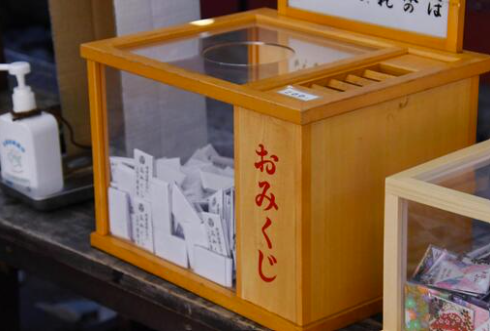
After offering your prayer to the deity, proceed to the ticket booth, usually located on one side of the main aisle. A donation of 100 yen, ranging up to 300 yen, will be requested. While the format may vary from place to place, Omikuji generally falls into two main forms:
- The paper that you pick yourself from a box or you simply plunge your hand in and hope to touch the best fortune.
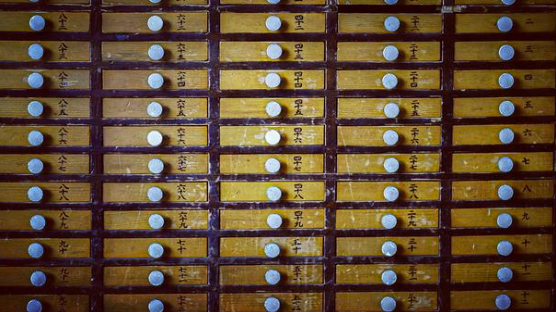
- The bamboo stick divination method, as practiced at the famous Sensōji Temple in Asakusa, involves taking the cylindrical box containing the sticks and gently shaking it. Upon turning it over, a stick will pop out with a number written on one side. You must then find the drawer corresponding to that number and take the fortune slip inside. Depending on the location, you may need to ask the temple staff directly for the slip in exchange for the number.
Once you've drawn your prediction with all your willpower, unfold the paper slightly. You'll probably be confused by all the Japanese symbols and characters, but don't worry! For the past few years, predictions in English have been available at the most well-known shrines and temples.
Classification of wealth
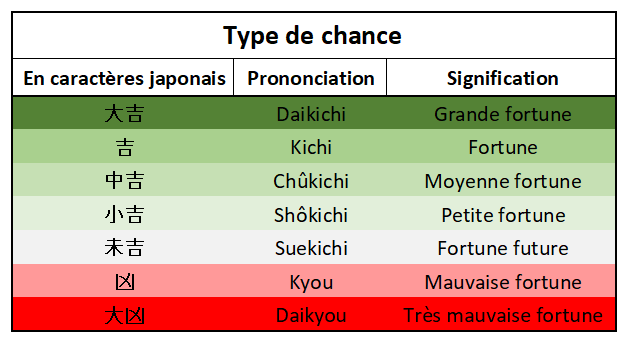
Predictions are generally broken down into 7 types of luck or fortune, ranging from the most beneficial 大吉 to the worst 大凶.
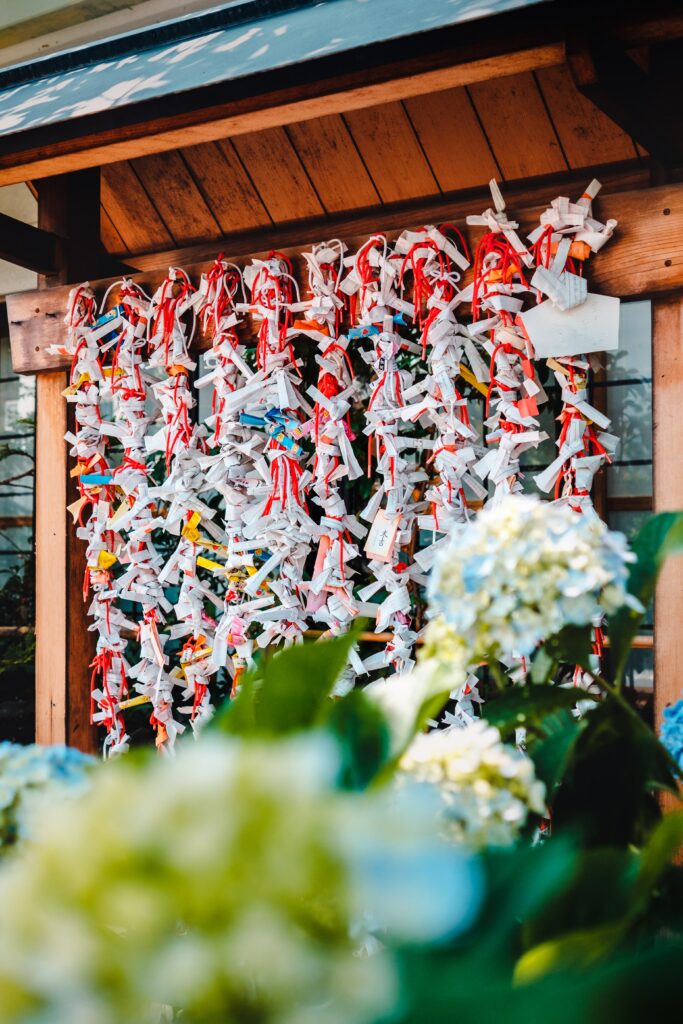
You will likely be disappointed, perhaps even worried, if you receive a bad omen represented by the character 凶 Kyou, but rest assured. While it is traditional to take good fortune with you, you can choose to hang bad omens on one of the strings placed to the side. These omikuji, considered bad omens, will then be burned by the temple staff and purified by the kami, or deity of the place.
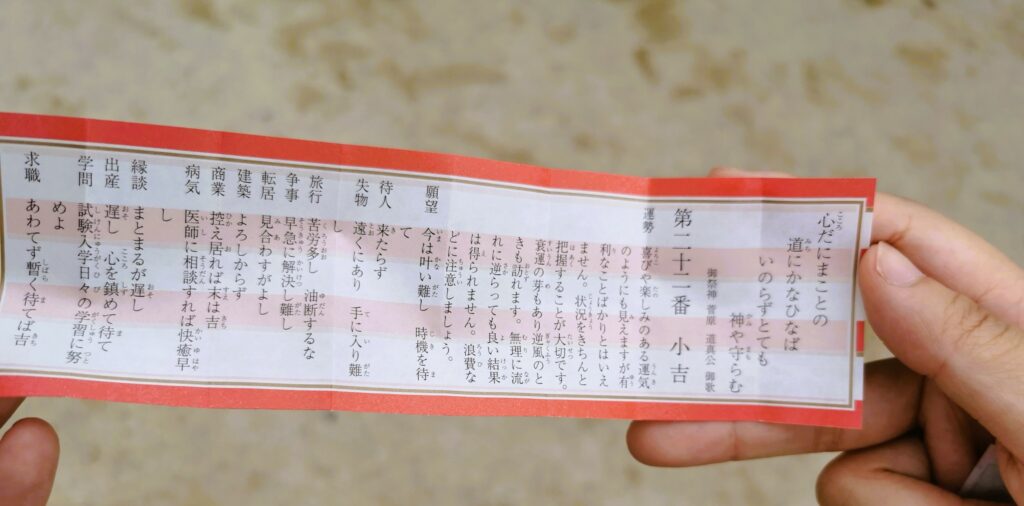
Example of an Omikuji
Omikuji are generally written in classical Japanese, making them often difficult to understand, even for Japanese speakers. We will attempt to translate some passages below:
Kenchiku, or building one's house: it is written よろしからず which could be translated as "it is not the right time to build one's house"«
Endan, or marriage proposal: it is written まとまるが遅し which could be translated in the context of marriage as "it will take time to come to fruition but it is not impossible"«
The missing thing, or "this thing," is written 遠くにあり 手に入りがたし, which could be translated as "this thing is far away, but getting hold of it will not be easy."«
![[Japon Pratique] Où faire ses courses à Tokyo ?](https://espaceprof.com/wp-content/uploads/2021/10/shopping-2615482_1280-1-400x300.jpg)
![[Japon Pratique] Faire un transfert bancaire (furikomi)](https://espaceprof.com/wp-content/uploads/2022/09/giovanni-gagliardi-b1omwFGldMU-unsplash-scaled-400x300.jpg)