
May 20th is Romaji Day (ローマ字, literally "Roman alphabet"). Romaji are the characters of the Latin alphabet used to transcribe the Japanese language. Let's look back at their origins and the place they hold today in the Japanese linguistic landscape.
The Appearance of the Romaji (ローマ字)
 The earliest transcriptions of Japanese date back to the 16th century.th century. They were designed by Portuguese missionaries who wished to communicate with the Japanese.
Learning the Japanese language was a major challenge. To make it more accessible, missionaries developed dictionaries based on the Latin alphabet. The first Japanese book written in romaji appeared in 1591: it was a religious book, written by the Portuguese Jesuit Alessandro Valignano (photo).
The development of transcriptions
Several transcriptions have been proposed since the 16th century.th century. Even today, different systems coexist.
- The Hepburn method (ヘボン式, Hebon shiki)
 It was devised by a group of Japanese and foreigners, including the American missionary James Curtis Hepburn. This method is based on a phonetic transcription of Japanese. Driven by a strong desire to make the Japanese language known to Westerners, Hepburn published the first Japanese-English dictionary for Westerners in 1867.
- The Nippon-shiki method (日本式)
This romanization method was proposed in 1885 by Tanakadate Aikitsu. It is closer to the logic of the kana writing system.
- The Kunrei-shiki method (訓令式)
It was introduced by the Japanese Ministry of Education between 1937 and 1954. It is a modern version of the Nippon-shiki transcription that better illustrates Japanese grammar. The ISO 3602:1989 standard establishes it as the official transcription standard for Japanese.
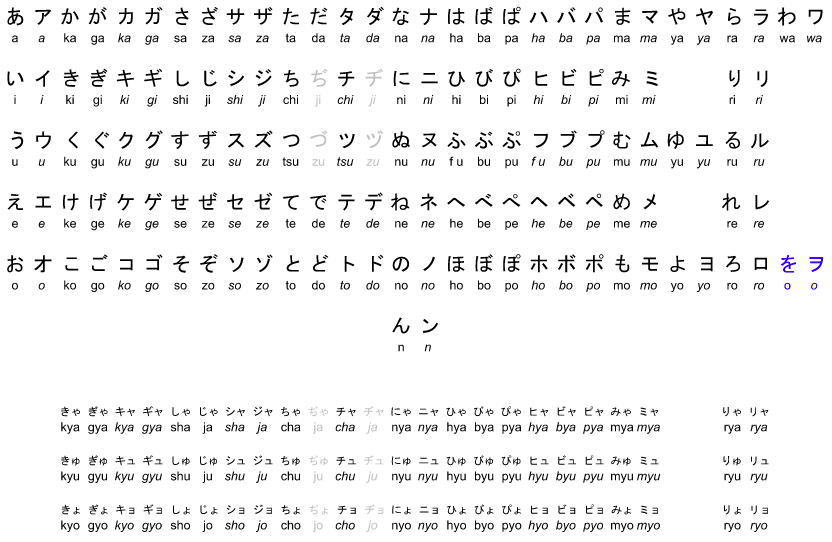
Photo : Byron Mayfield, CC BY-SA 3.0 via Wikimedia Commons
- The main difference between these different methods
It is simple: the Hepburn system aims to make Japanese easy for Westerners to pronounce, while the more regular Kunrei system is intended for Japanese people.
In practice, the Hepburn method remains the most widely used, including in Japan. It can be found in Japanese language learning textbooks and on road signs.
Romaji (ローマ字) today
Western culture generated widespread enthusiasm during the Meiji era (1868–1912), leading to a movement advocating the adoption of romaji (ローマ字) to replace the written language. However, efforts to simplify kanji and kana diminished the possibility of romaji (ローマ字) assuming a central role.
While romaji (ローマ字) is rarely used to write entire sentences today, it can be found on road signs, posters, and packaging. Here's an overview of the uses of Latin characters in the Japanese language:
- To overcome technical incompatibilities when traditional characters are not available (web addresses, emails, etc.)
- Entering texts from a Latin keyboard (often QWERTY) in word processing software, and more generally in human-machine interfaces.
- Transcribing Japanese names for Westerners: road signs, names of train stations and subway stations, names and surnames on passports, etc.
- Write certain acronyms such as NHK (pronounced enuetchikē), abbreviation of Nihon Hosō Kyōkai, the public broadcasting service or OL (pronounced ōeruOffice Lady, office worker.
- Attracting attention in advertisements: romaji reflect correct Japanese pronunciation and allow a message to be communicated (unlike English words and phrases, which often play a decorative role).
- Working with algebra: y = x² + 5x + 4 (ワイ イコール エックス 二乗 足す 五 エックス 足す 四, wai ikōru ekkusu nijō tasu go ekkusu tasu yon).
Romaji (ローマ字) in learning Japanese
Source : https://www.nippon.com/fr/japan-topics/b05609/
In beginner Japanese textbooks, romaji (ローマ字) is often used instead of hiragana. Some argue against using the Latin alphabet, given its limited use in written Japanese. It's true that studying kana as early as possible is beneficial for learning to read quickly. Furthermore, the different romaji (ローマ字) systems can be confusing.
However, it seems excessive to completely ignore romaji (ローマ字). Indeed, by watching anime, reading manga, or visiting Japan, one observes that the Latin alphabet occupies a distinct place in the written language.