Here we present three yōkai (妖怪), supernatural creatures prevalent in Japanese folklore. They are often depicted as mischievous or malevolent spirits, representing everyday or unusual troubles.
Fans of Japanese myths and legends, this article will delight you!
What is a yōkai? (妖怪) ?
The word yōkai is composed of the kanji 妖, "attractive", "bewitching" or "calamity", and 怪, "apparition", "mystery", "suspicious".
Their behavior ranges from playful to malevolent. Occasionally, they bring good or bad luck to those they encounter. They often possess animal attributes; they may also have more human features or resemble inanimate objects. Yōkai often possess supernatural spiritual powers.
Japanese folklorists and historians use the term youkai to designate "supernatural or inexplicable phenomena for those who witness them." During the Edo period, many artists, such as Toriyama Sekien, created yōkai, either ex nihilo or inspired by folklore. Thus, some yōkai are considered—wrongly!—to be beings of legendary origin.
The yōkai Yamata-no-Orochi (八岐大蛇)
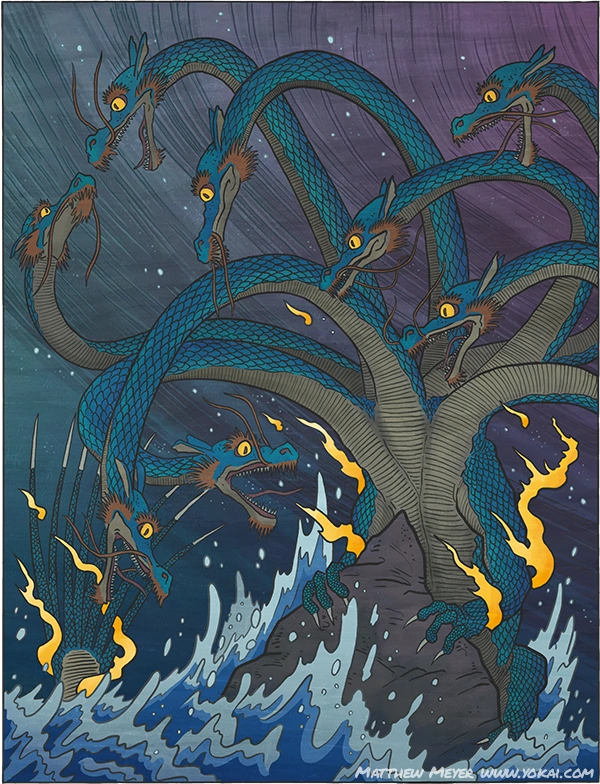
This is a demonic dragon with eight heads and eight tails. Its gigantic body stretches across eight valleys and eight mountains (that's all!). Its story is told in the Kojiki (古事記), the oldest Japanese collection of myths, dating from the early 8th century.th century.
Expelled from heaven, Susanoo (素戔嗚命/須佐之男命), the god of storms, arrived on Earth. He encountered two earth deities in despair after their daughters had been sacrificed to the great serpent. Aware of the difficulty of defeating Orochi head-on, Susanoo prepared eight large vats of liquor. After all the heads had collapsed, Susanoo cut the dragon into pieces. In one of the tails, he found a powerful sword, Kusanagi-no-Tsurugi (草薙の剣). This blade became one of the three sacred treasures of Japan. It is said to be kept today at the Atsuta Shrine in Nagoya.
THE Reiki (霊鬼)
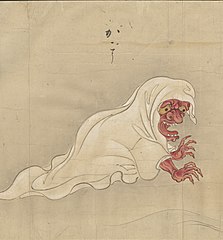
Reiki (霊鬼) are the spirits of demons (oni 鬼). Powerful and more ferocious than human spirits, reiki feed on the desire for revenge and appear surrounded by a luminous aura. Demons (oni 鬼) are known to be difficult to kill; therefore, reiki are much rarer than human spirits.
The word first entered the Japanese language in the 10th century.th century. It appears in the collection Konjaku Monogatari (今昔物語集), which tells many stories of supernatural creatures.
The most famous reiki is that of the oni ghost of Gango-ji Temple. He was a lazy and wicked servant, once employed by the temple. Upon his death, the servant's spirit transformed into a demonic ghost and killed the temple priests.
The yōkai Ao Bozu (青坊主)
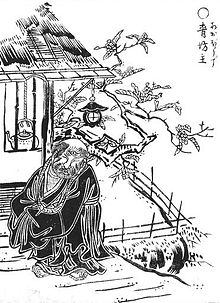
The Ao Bozu (青坊主) first appeared in 1776 in the Gazu hyakki yagyō (画図百鬼夜行, The Illustrated Night Parade of One Hundred Demons), the first yokai bestiary by artist Toriyama Sekien (鳥山石燕).
His illustration depicts a solitary Buddhist priest in a mountain hut. Tall and robust, he sports a single eye on a round head. The name Sekien gave his illustration, Ao Bozu, could have several meanings.
Thus, ao (あお), or blue in Japanese, also means young or unqualified. An Ao Bozu could therefore be a novice priest, or an imposter wearing priestly robes. The name could also refer to his skin color. However, since Sekien's original illustration is in black and white, we can only speculate…
Whatever Sekien's original intentions, numerous legends have arisen throughout Japan about this creature. In most cases, the Ao Bozu is literally blue. It is said to appear mysteriously at dusk. It then issues a challenge (a riddle or a sumo match), and defeat often means death for the loser.